
Window Treatments Explained: Types, Trade-offs, and What Actually Works
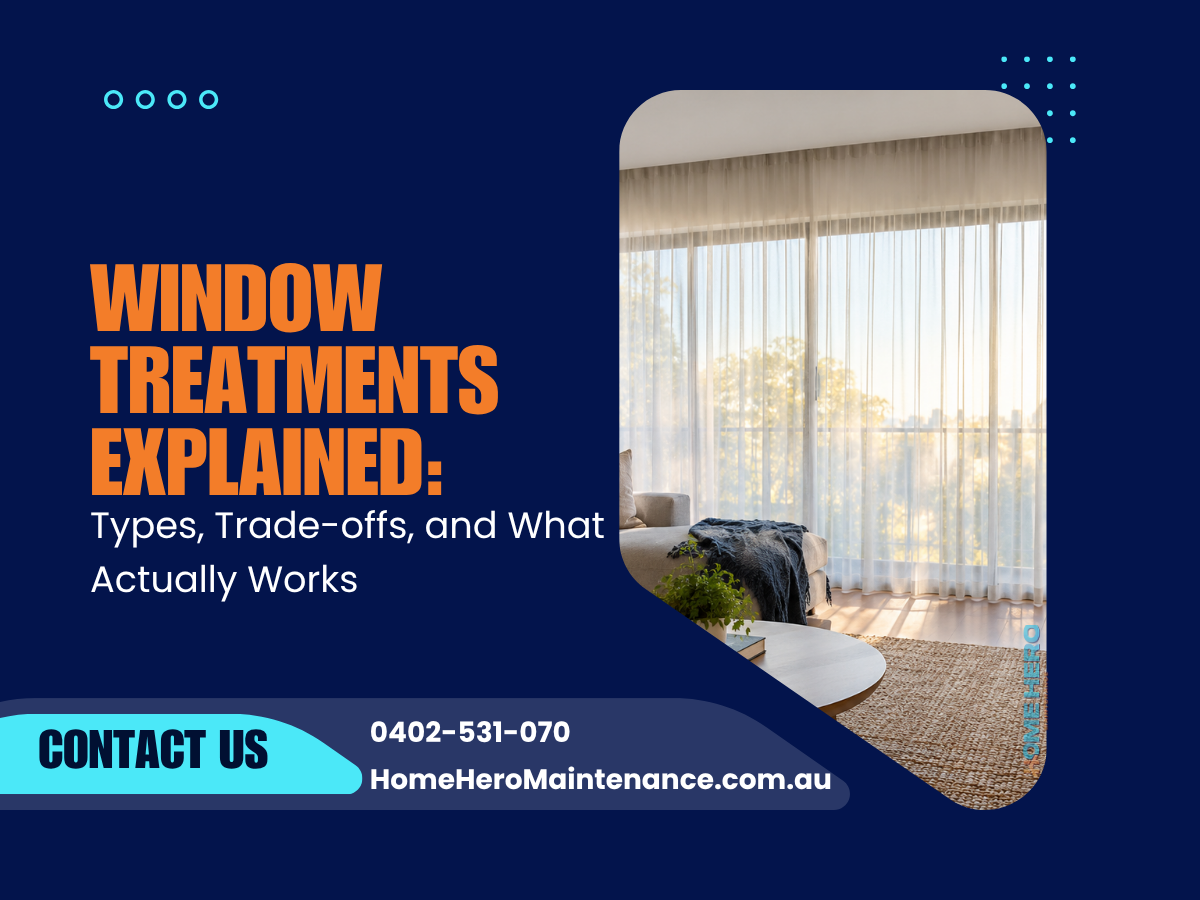
A window treatment is any covering, dressing, or decorative addition applied to a window to control light, privacy, or aesthetics. The category spans hard coverings like blinds and shutters through to soft fabric options like curtains, drapes, and Roman shades.
Understanding what is a window treatment matters most when you are renovating, decorating, or simply trying to fix a glare problem that makes your lounge unwatchable on a summer afternoon.
Who this is for: Homeowners, renters, and commercial property managers in Sydney who are deciding between window covering options and want a clear comparison before spending money.
Not for: Readers already set on a specific product who are looking for installation instructions or DIY tutorials.
Key Takeaways
Window treatments cover a wide spectrum: from fabric curtains and Roman blinds to timber shutters and frosted film.
Hard treatments (shutters, blinds, venetians) generally outlast soft treatments (curtains, drapes) but cost more upfront.
Light control and privacy are separate problems; the best treatments address both without compromising the other.
Sydney's coastal and suburban climates create specific demands: UV fade resistance, humidity tolerance, and insulation all matter here.
Clean glass behind the treatment is just as important as the treatment itself; grimy windows undermine even premium coverings.
Stacking a sheer with a blockout is the most practical solution for rooms that need both daytime light and night-time privacy.
Hard vs Soft: The Core Divide
Before getting into individual products, it helps to understand the two structural categories that organise every option on the market.
Hard treatments use rigid or semi-rigid materials. Think aluminium venetian blinds, PVC vertical blinds, basswood shutters, roller blinds with a fibreglass weave, and cellular (honeycomb) blinds. Their main strengths are durability, ease of cleaning, and precise light control. The trade-off is that hard treatments rarely add warmth to a room visually, and some, particularly PVC verticals, can look institutional in residential spaces.
Soft treatments use fabric. Curtains, drapes, Roman shades, balloon blinds, and café curtains all fall here. Fabric brings texture, colour, and acoustic softness to a room. The catch is that fabric traps dust, fades in direct sun, and typically needs professional cleaning or careful hand-washing. In high-humidity areas of Sydney, particularly older terraces without ducted air conditioning, fabric treatments can also develop mould along hems and rod pockets if airflow is poor.
| Feature | Hard Treatments | Soft Treatments |
|---|---|---|
| Durability | 10 to 20+ years (timber, aluminium) | 5 to 15 years (depending on fabric weight and UV exposure) |
| Light control | Precise (adjustable slats or weave density) | Variable (sheers let light through; blockouts seal well) |
| Ease of cleaning | Wipe-down, vacuum, or water-fed cleaning | Dry-clean, hand-wash, or specialist service |
| Insulation value | Moderate (cellular blinds are best here) | High (heavy drapes trap a significant air layer) |
| Visual warmth | Low to moderate | High |
| Cost range (Sydney) | A$80 to A$600 per window | A$150 to A$1,200+ per window (custom-made) |
In practice, the pattern that keeps appearing in Sydney homes is a hard treatment for the bedroom (for blackout and humidity tolerance) combined with a soft sheer in living areas for aesthetics. Neither category wins outright.
Common Types You Will Actually Encounter
Roller blinds are the workhorse of the Australian market. You can get them in sunscreen fabrics that reduce glare while preserving the view, or in full blockout fabrics. They sit flat against the window, making them ideal for narrow window recesses common in Federation-era Sydney homes. The downside: cheap roller blind mechanisms wear out inside two years under daily use, so paying slightly more for a quality cassette system is worth it.
Roman blinds sit between hard and soft. They use fabric but fold into horizontal pleats when raised. They look polished in home offices and dining rooms. Where they fall short is that the folded fabric collects dust rapidly, and the cords or chains require occasional maintenance.
Venetian blinds in basswood or aluminium give you the finest light control of any category. You can angle slats to direct light toward the ceiling rather than at your screen, which is something roller blinds cannot do. The trade-off is that dust settles into each slat and cleaning them properly is genuinely time-consuming.
Plantation shutters are the premium option Sydney buyers are increasingly choosing, according to insights found through water fed cleaning poles vs traditional window cleaning. Painted MDF or real timber louvred panels fold or swing open like interior shutters. They add value to a property, according to multiple real estate agents quoted by the Sydney Morning Herald, and they are genuinely durable. The catch is cost: A$700 to A$1,800 per window installed is common for custom timber shutters in Sydney.
Curtains and drapes remain the highest-impact decorative option. Floor-to-ceiling drapes hung close to the ceiling make rooms feel taller and more finished. But they require a wall space beside the window for stacking, which rules them out for tight alcoves.
Window film (frosted, tinted, or UV-blocking) is worth mentioning because it is often overlooked. Applied directly to the glass, film adds privacy in bathrooms or street-facing rooms without blocking light. It is not technically a treatment in the traditional sense, but it solves real problems cheaply.
Light Control and Privacy: Two Separate Problems
Most people buying window treatments conflate light control and privacy. They are related but distinct.
Light control refers to how much natural light enters the room and from what angle. Privacy refers to whether people outside can see in. A sheer curtain, for example, provides excellent daytime privacy from a distance but zero privacy at night when your interior is lit. A 3% openness sunscreen roller blind reduces glare and UV while keeping the view; a pedestrian one metre away can still see you clearly.
The standard solution in Australian interior design, particularly in Sydney's inner suburbs, is a double bracket system: a blockout roller blind on the inside track for night-time privacy, and a sheer or sunscreen on the outer track for daytime use. This costs more upfront but eliminates the need for compromise.
For commercial settings, the considerations shift. Glare on screens, energy efficiency under the National Australian Built Environment Rating System (NABERS), and safety compliance for cord-operated blinds in public spaces all become relevant. Commercial-grade options, typically motorised roller blinds or vertical blinds in fibreglass weave, address those needs more reliably than residential products.
You can read more about professional window care on the HomeHero blog, which covers everything from glass scraper safety to choosing the right cleaning method for high-rise windows.
| Window Type | Recommended Treatment | Why |
|---|---|---|
| Street-facing lounge, Sydney terrace | Sheer + blockout double roller | Daytime privacy without blocking light; night-time blackout |
| Home office with screen glare | 3-5% openness sunscreen roller | Reduces glare and UV while preserving view |
| Bathroom (privacy essential) | Frosted window film or café curtain | Permanent privacy, low cost, humidity tolerant |
| Bedroom, coastal suburb | Blockout plantation shutter | UV fade resistance, humidity tolerance, long-term durability |
| Open-plan commercial office | Motorised fibreglass vertical blind | NABERS compliance, cord-free safety, scalable |
| High-rise apartment balcony door | Aluminium venetian or motorised roller | Wind resistance; no fabric to deteriorate in UV and salt air |
Why Clean Windows Matter as Much as the Treatment
Here is what usually trips people up: they invest A$2,000 in custom drapes and then wonder why the room still feels dingy. The glass itself is the problem. Grimy, streaked windows reduce the effectiveness of every treatment above them because the light that enters is already diffused and yellowed by the film of pollution, salt, and oxidised grime on the exterior pane.
This is particularly relevant in Sydney's coastal suburbs, where salt spray deposits build up on glass weekly, and solutions for how to clean hard to reach outside windows become essential for many homeowners. The answer is usually a professional service with pure-water pole technology, which reaches up to four storeys without ladders. For stubborn mineral deposits on glass before installing a new treatment, a glass scraper can be effective, and understanding how to safely use a window glass scraper resource covers the technique properly, because used incorrectly, a scraper will scratch rather than clean.
Choosing a Treatment for Sydney's Climate
Sydney's climate sits in a humid subtropical zone, which creates specific demands that a purely aesthetic choice will ignore. UV index in Sydney regularly reaches "extreme" levels from November through to February, according to the Australian Radiation Protection and Nuclear Safety Agency (ARPANSA). That means untreated fabric will fade noticeably within one to two years on north-facing windows.
For north and west-facing rooms, UV-stabilised roller blind fabrics, timber shutters with a UV-resistant lacquer, or external awnings are more appropriate than lightweight cotton curtains. Coastal suburbs from Manly to Cronulla also deal with salt-laden air that accelerates corrosion on metal components, particularly aluminium head rails and chains. Stainless steel fixings and powder-coated aluminium (rather than bare) hold up significantly better.
For practical advice on selecting and maintaining window services at a commercial scale, the top commercial window cleaners in sydney resource is a useful reference for those managing large properties. If you are currently researching professional help, hiring the best window cleaning service in sydney walks through the key questions to ask any company before booking.
The Australian Window Association also publishes guidelines on energy ratings for window products, which is increasingly relevant for both residential renovations and commercial fitouts seeking a NABERS improvement.
What Actually Drives the Decision
In practice, three factors decide the final choice for most Sydney buyers: budget, the direction the window faces, and how much maintenance the occupant is realistically willing to do.
Budget caps the field quickly. A single custom-made plantation shutter can cost more than five rooms of builder-grade roller blinds. Both solve the core problem of what is a window treatment, but they sit at opposite ends of a wide cost spectrum.
Window orientation determines the severity of UV exposure, heat load, and the need for insulation. South-facing rooms in Sydney receive indirect light year-round and can use almost any treatment. North and west-facing rooms need serious UV and heat protection.
Maintenance willingness is where honest trade-offs matter most. Venetian blinds require regular dusting. Fabric curtains need periodic cleaning. Shutters need occasional touch-ups on painted surfaces. Roller blinds in a good cassette system are genuinely close to zero-maintenance. Pick the option that fits your actual habits, not your aspirational ones.
Book a Professional Window Clean Before You Hang Anything
New treatments look their best the day they go up. Make sure the glass behind them is spotless before installation day. HomeHero Window Cleaning serves residential and commercial properties across Sydney, Western Sydney, the Hills District, and South West Sydney, using eco-friendly pure-water pole systems that leave glass streak-free without ladders or safety risks.
Call HomeHero today on 0402 531 070 for a free, no-obligation quote. A uniformed, insured crew will arrive on time and clean every pane, track, and flyscreen to a streak-free finish, guaranteed, or they come back and re-clean for free.
Frequently Asked Questions
What is the meaning of window treatment?
A window treatment is any product or material applied to a window to manage light, privacy, temperature, or appearance.
The term covers a wide spectrum, from hard products like venetian blinds, roller blinds, and plantation shutters through to soft fabric options like curtains, drapes, and Roman shades. It also includes window film applied directly to the glass. The word "treatment" reflects the idea that the window itself is being addressed as a design and functional problem, not simply covered up.
Are window treatments the same as blinds?
No. Blinds are one type of window treatment, but the category is much broader than blinds alone.
Blinds refer specifically to hard or semi-rigid coverings with adjustable slats or a rolling mechanism, such as venetians, verticals, and roller blinds. Window treatments include blinds, but also curtains, drapes, shutters, Roman shades, café curtains, and window film. Treating the two terms as interchangeable causes confusion when shopping, because a retailer selling "window treatments" will stock products well beyond what most people picture when they think of a blind.
Why do they call it window treatments?
The term comes from interior design language, where "treating" a surface means addressing it both functionally and aesthetically.
The phrase became common in professional decorating during the mid-twentieth century, when interior designers began distinguishing between structural window elements (the frame, the glass, the sill) and the decorative and functional layers applied on top of them. Calling it a treatment signals that the approach involves considered choices about fabric, hardware, and layering, not just hanging something to block light. Today the term is standard across the Australian window furnishings industry.
What are some examples of window treatments?
Common examples include roller blinds, venetian blinds, plantation shutters, Roman shades, curtains, drapes, cellular blinds, vertical blinds, café curtains, and window film.
Each solves a slightly different problem. Roller blinds in a blockout fabric are popular in Australian bedrooms for their simplicity and UV resistance. Plantation shutters are frequently chosen for living areas in Sydney homes where durability and property value are priorities. Roman shades suit dining rooms and home offices where a polished, fabric-based look is preferred. Window film works well in bathrooms or street-facing windows where permanent frosted privacy is needed without any hanging mechanism.
What is the most popular type of window treatment?
Roller blinds are consistently the most popular window treatment in Australia, particularly in new builds and apartment renovations.
Their popularity comes down to three practical reasons: they are relatively affordable, they suit the narrow window recesses common in Australian residential construction, and they are available in a wide range of fabrics from sheer sunscreen to full blockout. The trade-off is that cheap roller blind mechanisms wear out quickly under daily use, so quality of the cassette and chain system matters significantly. Plantation shutters are the fastest-growing premium category, but roller blinds remain the default choice across Sydney's residential market.
The Bottom Line on What Is a Window Treatment
Understanding what is a window treatment properly means moving past the idea that it is simply a blind or a curtain. It is the full system of coverings, fabrics, hardware, and films that controls how light, heat, and visibility interact with a window. The right choice depends on window orientation, budget, humidity exposure, and how much maintenance you are prepared to do consistently.
In Sydney's climate, with high UV levels, coastal salt air in many suburbs, and strong summer sun through north and west-facing windows, that decision carries real consequences for how long your chosen treatment lasts and how well it performs. Start with the glass itself, clean and streak-free, then choose the treatment that fits the room's function first and its aesthetics second. Call HomeHero Window Cleaning on 0402 531 070 to get the glass ready before your new treatments go up.